Window Education
Specialty Shape Windows: Arched, Eyebrow, and Elliptical Explained
By Jeremy Holzmeister · · 8 min read
If your home has a blank wall above the front door, a dim stairwell landing, or a gable end that feels flat from the street, a specialty shape window might be the upgrade you have not considered. Specialty shape windows are arched, eyebrow, elliptical, circular, and other non-rectangular forms. They add architectural character that standard windows cannot replicate. They still deliver real daylight and energy performance. At Innovate Window and Door, we install specialty shape windows across Montrose and Western Colorado. Homeowners often tell us they wish they had asked about them sooner. Here is what each shape does best, where it fits, and what to expect when you order one.
What Are Specialty Shape Windows, and Why Do They Matter?
Specialty shape windows are windows fabricated in a form other than the standard rectangle. Think arches, half-rounds, eyebrows, ellipses, circles, triangles, trapezoids, and custom multi-sided geometries. Most are fixed units, meaning they do not open. Their job is not ventilation. Their job is light, proportion, and architectural expression.
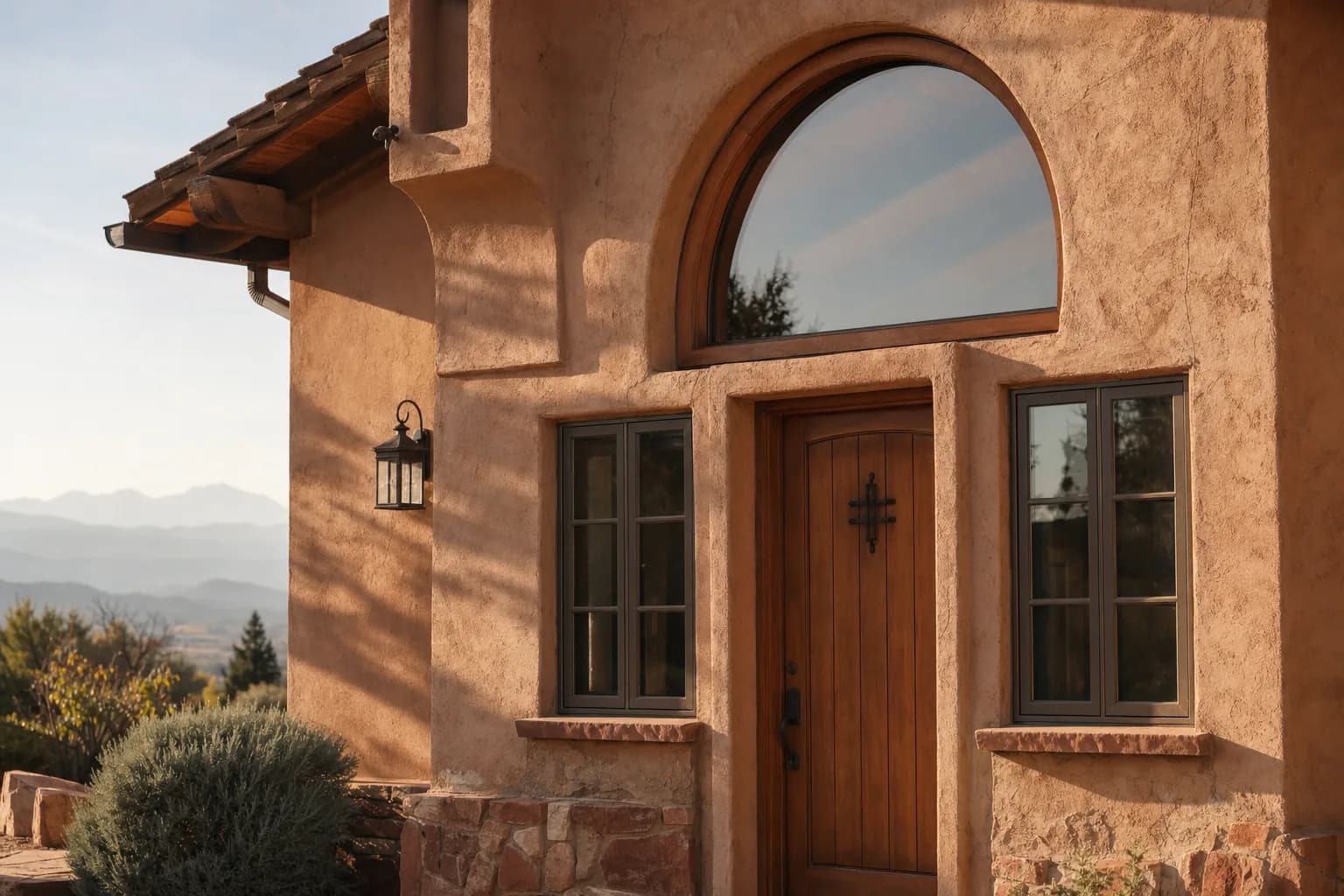
That distinction matters when you plan a project. A specialty shape window is almost never chosen on its own. It is usually paired with operable casement, awning, or double-hung windows nearby. The fixed shape handles the visual statement, and the neighboring units handle airflow. Picture an arched transom above a pair of casement windows flanking a front entry. Or a circular window centered in a gable end above a row of standard double-hungs. The composition, not any single window, is what reads as intentional from the street.
Western Colorado's building stock gives specialty shapes a lot of room to work. Southwestern stucco homes around Montrose, craftsman bungalows, log and timber-frame structures, and contemporary mountain-modern builds each have a different architectural vocabulary. The right specialty window reinforces that vocabulary instead of fighting it. A half-round window above a craftsman entry door looks historically appropriate. An eyebrow window tucked into a roofline adds light to a space that would otherwise stay dim. A circular window on an end gable becomes a focal point, visible from both the street and the room behind it.
Arched Windows: The Classic Architectural Accent
Arched windows are the most familiar specialty shape, and for good reason. A radius-top or full arch window softens the hard lines of a rectangular opening. It reads as more formal and more traditional than a standard rectangle. They show up most often in three configurations: a full arch used as a standalone accent window, a half-round or radius-top transom placed above a doorway or a taller rectangular window, or a full arch replacing the top portion of an existing opening during a remodel.
Arched windows work well over entry doors and above stacked window groupings. The curve draws the eye upward and gives an otherwise plain facade a sense of proportion. They also pair naturally with two-story foyers and stairwell landings, where the extra height of an arch brings daylight deep into a space a standard window could not reach.
Because an arch is a fixed shape, the interior trim work takes more skill than a standard window casing. Curved casing has to be scribed and fitted piece by piece, not cut from stock lumber. The quality of the finish carpentry matters as much as the window itself. This is one detail worth asking about when you compare installers.
Eyebrow Windows: Subtle Curves With Outsized Character
An eyebrow window is a low, wide arch, shaped roughly like a raised eyebrow. It follows a gentle curve rather than a full or half circle. They are most often installed within a roofline, either as a dormer-style feature or set into a knee wall. There, they bring light into an attic bedroom, a loft, or a bonus room without requiring a full dormer addition.
Eyebrow windows carry a quiet, custom feel that larger arched or circular windows do not. Because the curve is so shallow, an eyebrow window tends to blend into the roofline rather than announce itself. That makes it a good fit for homeowners who want architectural interest without a dramatic statement. They are also one of the harder shapes to fabricate and flash correctly. The curved head has to integrate cleanly with roofing material rather than standard wall siding. That makes proper flashing and water management especially important. It is worth confirming with your installer that they have handled eyebrow windows before.
Elliptical and Circular Windows: Balanced Focal Points
Elliptical and circular windows share a family resemblance. Both are symmetrical. Both draw the eye to a fixed point. Both work best when a home has a natural place for a focal-point window, such as a gable end, a stairwell wall, or a powder room where privacy matters more than a view.
Circular windows are the boldest of the two. A single circle centered on a wall or gable becomes the visual anchor of that elevation. Because they are so symmetrical, placement has to be precise, or the window will look off balance against the rest of the facade. Elliptical windows soften that same idea into a wider, less formal shape. They read well in pairs or as an accent above a picture window.
Both shapes work well with decorative or obscure glass in bathrooms and stairwells, where daylight is welcome but a clear view in or out is not. Since these are almost always fixed units, glass selection deserves extra attention. A Low-E coating matters even more on a fixed specialty window in a sun-exposed spot, since there is no way to open the window and release trapped heat. For more on glass coatings and how they affect comfort, see our guide on choosing window styles by room.
Choosing the Right Shape and Knowing What to Expect
Matching a specialty shape to your home comes down to architecture, location, and purpose. The table below is a starting point, not a rulebook. Your home's specific rooflines, ceiling heights, and elevations will drive the final decision.
| Shape | Best used for | Typical placement | Ventilation |
|---|---|---|---|
| Full arch | Formal accent, entry statement | Above a door or paired window group | None, fixed |
| Half-round / radius-top | Transitional accent, transom | Above a doorway or existing window | None, fixed |
| Eyebrow | Subtle roofline feature | Dormer, knee wall, attic space | None, fixed |
| Elliptical | Soft focal point, pairs well | Gable end, above a picture window | None, fixed |
| Circular | Bold single focal point | Gable end, stairwell wall | None, fixed |
| Triangular / trapezoid | Filling an angled opening | Under a roof pitch, alongside a gable | None, fixed |
A few practical points apply no matter which shape you choose.
- Specialty shape windows are fabricated to the exact dimensions of your rough opening. They are not trimmed down from a standard stock size, so accurate measuring matters more than it does on a standard window.
- Lead times run longer than standard windows, since each unit is built to order. Planning ahead keeps a remodel timeline moving smoothly.
- Interior trim and exterior flashing take more skill on curved and angled shapes than on rectangular windows. Ask any installer about their experience with the specific shape you want.
- Nearly any glass package available on standard windows, including Low-E coatings and argon or krypton gas fills, is also available on specialty shapes. You do not have to trade energy performance for architectural style.
If you already know what window style you want throughout the home and are figuring out how specialty shapes fit into the bigger picture, our post on window styles explained is a useful companion to this one. And if you are pairing a specialty shape window with new frame colors, our black window frames guide covers how dark frames read against different exterior finishes. That choice matters more on a bold shape like a circle or full arch than on a standard rectangle.
Bring Your Architectural Vision to Life
Specialty shape windows change how a home looks from the street and how a room feels from the inside, at the same time. Maybe you are working with an architect on new construction. Maybe you want to add an eyebrow window to a bonus room. Or maybe you simply want to replace a plain rectangular opening with something that matches your home's character. Either way, the right shape starts with a conversation about your specific rooflines, elevations, and goals.
Innovate Window and Door is a locally owned Montrose, Colorado company serving Western Colorado, including Delta, Grand Junction, Ouray, Ridgway, Telluride, Gunnison, Crested Butte, Cedaredge, Olathe, and the surrounding communities. We source and install specialty shape windows from ProVia, Andersen, and Pella, and we handle both residential and commercial projects. If you are ready to explore arched, eyebrow, elliptical, or other custom window shapes for your home, contact us for a free estimate. Let us help you design a window that reflects your home's character rather than a catalog page.
About the author
Jeremy Holzmeister is the founder of Innovate Window and Door, a locally owned window and door company in Montrose, Colorado, with more than fifteen years of experience in the trade. Learn more about our team.