Commercial Doors
How Often Do Fire Doors Need to Be Inspected?
By Jeremy Holzmeister · · 7 min read
If you manage a commercial building, you have probably wondered how often fire doors need to be inspected. The honest answer is more specific than most people expect. Fire door inspection frequency is not a judgment call you get to make on your own schedule. A national standard sets it, and your local fire marshal and your insurance carrier both expect you to follow it. Get it wrong and you risk a failed inspection, a voided warranty, or a door that will not perform during an actual fire. This guide covers what the code requires, who can sign off on an inspection, and what an inspector actually checks.
Fire Door Inspection Frequency: What NFPA 80 Requires
Here is the short answer. You must inspect and test fire door assemblies at least once a year. That rule comes from NFPA 80, the standard for fire doors and other opening protectives. Most jurisdictions that require fire-rated door assemblies reference NFPA 80 directly, often through the International Building Code. Every labeled fire door falls under this rule, whether it is a single swing door protecting a stairwell or a pair of doors separating a kitchen from a dining area.
A few wrinkles are worth knowing. Rolling steel fire doors carry an extra step. Along with the annual assembly inspection, they need an annual drop test. The inspector releases the door to confirm it closes fully under its own weight. Then they reset it and drop it a second time to check that the automatic closing device reactivated correctly. And once a year is a floor, not a ceiling. Doors in high-traffic corridors, doors that take a beating from cart traffic or forklifts, and doors with a history of problems often get checked more, sometimes quarterly. The people who manage those buildings decided that once a year would not catch issues fast enough.
New installations need an inspection too, and so does any door that just had maintenance work done. This is not a separate annual cycle. It is a checkpoint that happens every time someone touches the assembly. If your facility just replaced or repaired a fire-rated door, do not assume it is compliant until someone actually verifies it. We cover the full standard in more detail in our NFPA 80 fire door inspection explainer. For background on what makes a door fire rated in the first place, read our post on fire door ratings, which breaks down what those labels mean and why you cannot alter them in the field.
Who Is Actually Qualified to Do the Inspection
NFPA 80 requires a "qualified person" to perform the inspection, and it deliberately skips a rigid list of credentials. In practice, that phrase points to training and real, documented experience with fire door assemblies, not general facilities know-how. Many buildings default to whoever installed their doors, or to someone who holds an industry credential like DHI's Fire and Egress Door Assemblies Inspector certification.
Here is where I will push back on an assumption I see often. Your maintenance staff walking a hallway and eyeballing whether a door swings freely is not an NFPA 80 inspection, even if they are careful and thorough. The standard expects someone who can spot an out-of-tolerance gap, recognize a mismatched or missing label, and know what "operates as intended" really means for a self-closing, self-latching assembly. If you are not sure your current process clears that bar, that uncertainty alone is a reason to bring in someone who does this work for a living. Better to find out now than during a fire marshal visit.
What Gets Checked During a Fire Door Inspection
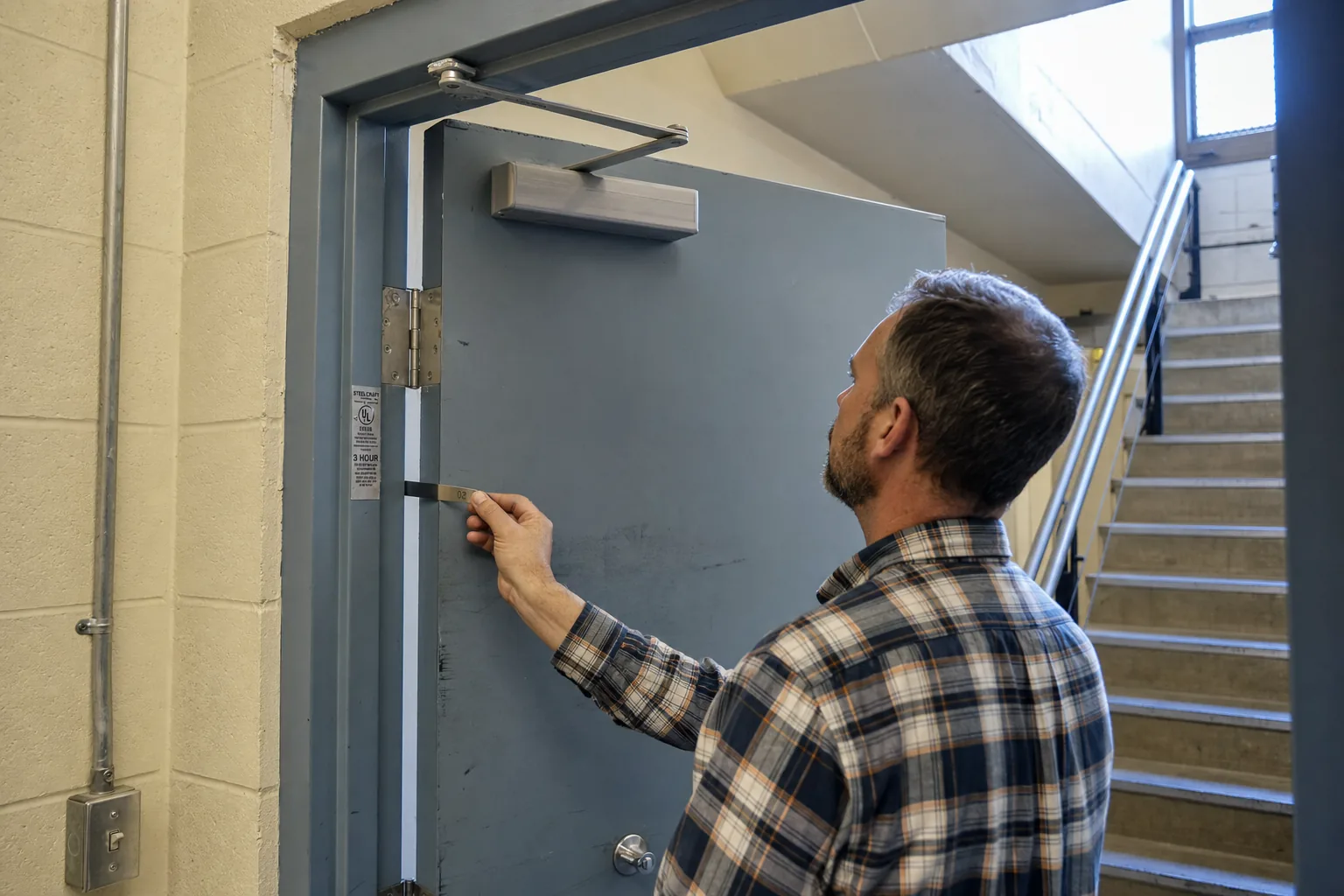
A real fire door inspection is not a glance. NFPA 80 lists more than a dozen specific items an inspector has to confirm. Most fall into a handful of categories.
| Component | What's checked | Standard it has to meet |
|---|---|---|
| Label | Legible, permanently affixed, matches the door's rating | No missing, painted-over, or altered labels |
| Clearances | Gap between door and frame | Maximum 1/8 inch at the top and sides, maximum 3/4 inch at the bottom |
| Hardware | Hinges, latch, closer, coordinator | All present, functional, and fire-rated for the assembly |
| Self-closing device | Closes and latches the door automatically | Door fully closes and latches from any open position, every time |
| Glazing and vision panels | Fire-rated glass, correct size for the label | No cracked or non-rated glazing installed |
| Field modifications | Holes, louvers, kick plates added after installation | No unauthorized penetrations or unlabeled hardware |
| Gasketing and seals | Smoke seals, intumescent strips where required | Continuous, undamaged, correctly installed |
That clearance line trips up more buildings than anything else. A door can fail on gap tolerance alone even when nothing looks wrong to someone walking by. Maybe it swelled slightly. Maybe it sagged on its hinges. Maybe a contractor swapped the threshold for one with the wrong height. The "no field modifications" rule catches people off guard just as often. Adding a keyed deadbolt, cutting a hole for a card reader, or drilling for a closer that was not part of the original listing can void the fire rating entirely, no matter how clean the work looks. If you are speccing new fire-rated door assemblies for a renovation or a new build, loop in whoever handles your inspections early, before hardware gets ordered.
Keeping Records Nobody Has to Hunt For
NFPA 80 requires a written record of every inspection, and you have to make that record available to the authority having jurisdiction on request. In plain terms: when the fire marshal asks, you need to produce it, not promise to email it later. The record should note the date, the inspector, each door assembly checked, and any deficiencies found, along with how and when you fixed them.
Most facility managers I have talked to underestimate how much easier this gets with a simple system. A spreadsheet with a door tag number, last inspection date, and next-due date is enough to end the annual scramble. Pair that with a broader maintenance calendar, and fire door inspections stop feeling like a special event. They become one more line item, the same way you would check a commercial door preventative maintenance checklist between seasons. Buildings that treat inspection as a recurring habit almost never fail one. Buildings that treat it as a once-a-year fire drill usually do.
What Happens When a Door Fails Inspection
Either way, the deficiency gets documented. What happens next depends on how serious it is. A worn gasket or a closer that needs adjustment is a minor fix. Most inspectors handle it on the spot or schedule it within days. A door that will not latch, has a compromised label, or has an unauthorized hole cut through it is a bigger problem. NFPA 80 expects you to correct deficiencies without undue delay. Depending on your local fire code and how severe the issue is, a door that cannot maintain its rating may need to come out of service, get propped open with a monitored alarm, or sit under an interim fire watch until someone repairs it.
This is usually where the conversation shifts from who inspects the door to who can actually fix or replace it. Not every commercial contractor stocks fire-rated hardware. Swap in the wrong closer or hinge to save time, and you turn a compliant door back into a non-compliant one. If you are working through a renovation or a Division 8 spec for a new build, our primer on Division 8 commercial door specifications walks through how fire ratings, hardware sets, and door schedules fit together, so replacements do not create the same problem twice.
Building the Habit Into Your Maintenance Calendar
Once a year sounds simple until you are the one tracking two dozen doors across a building with a rotating maintenance staff. The buildings that stay compliant put a real date on the calendar. They use a qualified inspector. They fix what gets flagged before the next walkthrough. The buildings that fall behind just hope nobody asks.
If you manage commercial property in Montrose, Delta, Grand Junction, or anywhere else across Western Colorado and you need fire-rated doors evaluated, repaired, or replaced, Innovate Window and Door works on commercial door assemblies, including fire-rated units through our CDF Distributors line. We offer free estimates for both residential and commercial projects. Reach out through our contact page to schedule a free estimate and get your fire door inspection cycle back on track before it becomes a compliance problem.
About the author
Jeremy Holzmeister is the founder of Innovate Window and Door, a locally owned window and door company in Montrose, Colorado, with more than fifteen years of experience in the trade. Learn more about our team.