Commercial Doors
NFPA 80 Explained: What It Means for Your Fire Door Inspection Program
By Jeremy Holzmeister · · 7 min read
If your building has fire-rated doors, someone eventually has to answer for whether they still work the way they did on installation day. That is the job an NFPA 80 fire door inspection does. It turns "the door probably closes fine" into a documented, code-enforceable standard that your local fire marshal, your insurance carrier, and your building department can all point to. For facility managers, NFPA 80 is not background reading. It sets the rulebook your fire door assemblies get measured against every year, whether you have read it or not.
This post walks through what NFPA 80 covers, what an inspector checks, how often inspections have to happen, and what tends to trip facilities up. At Innovate Window and Door, we supply and service commercial fire-rated door assemblies for buildings across Western Colorado, so we cover this ground often with property managers and building owners.
What NFPA 80 Actually Regulates
NFPA 80, Standard for Fire Doors and Other Opening Protectives, comes from the National Fire Protection Association. It governs how you install, inspect, test, and maintain fire door assemblies, along with fire windows and other opening protectives, in commercial and institutional buildings.
Building codes like the International Building Code do not spell out the mechanics of fire door upkeep themselves. Instead, they point to NFPA 80 and require compliance with it. That matters even if nobody at your facility has ever opened the actual standard: your local building code has already adopted it by reference, and your Authority Having Jurisdiction (AHJ), usually the fire marshal, enforces it.
It helps to think of NFPA 80 as covering the whole life of a fire door assembly, not just installation day. A testing laboratory rates a door, frame, hardware, and glazing package as a complete assembly and stamps it with a listing label. NFPA 80 keeps that assembly performing the way the lab tested it to perform for as long as you keep it in service.
What an NFPA 80 Fire Door Inspection Checks
An NFPA 80 fire door inspection goes well beyond a glance to see if the door swings shut. Section 5.2 of the standard lays out a specific set of items an inspector has to evaluate on every fire door assembly, and most inspection checklists in the industry build directly off it.
At a minimum, an inspector checks:
- The label. The fire rating label needs to stay legible, permanently affixed, and free of paint or damage that obscures it.
- The door leaf. No holes, breaks, or cracks, and no missing or altered parts.
- The frame. Anchored securely, undamaged, with any intumescent seal intact.
- Clearances. The gaps between door and frame, measured against maximum tolerances (more on this below).
- Hardware. Hinges, closers, latching hardware, and coordinators (on pairs of doors) present and working as listed.
- Self-closing and positive latching. The door has to close and latch on its own, every time, without help.
- Glazing. Vision panels or glass lites carrying a listing for the door's fire rating and installed correctly.
- Field modifications. No holes drilled for aftermarket hardware, no unlisted parts swapped in, nothing added that voids the original listing.
If any of those items fail, the assembly counts as deficient until someone fixes it. A fire door with an over-clearance gap or a missing closer cannot do the job the lab tested it for, even if it looks fine at a glance.
Clearance Tolerances: The Numbers Inspectors Measure
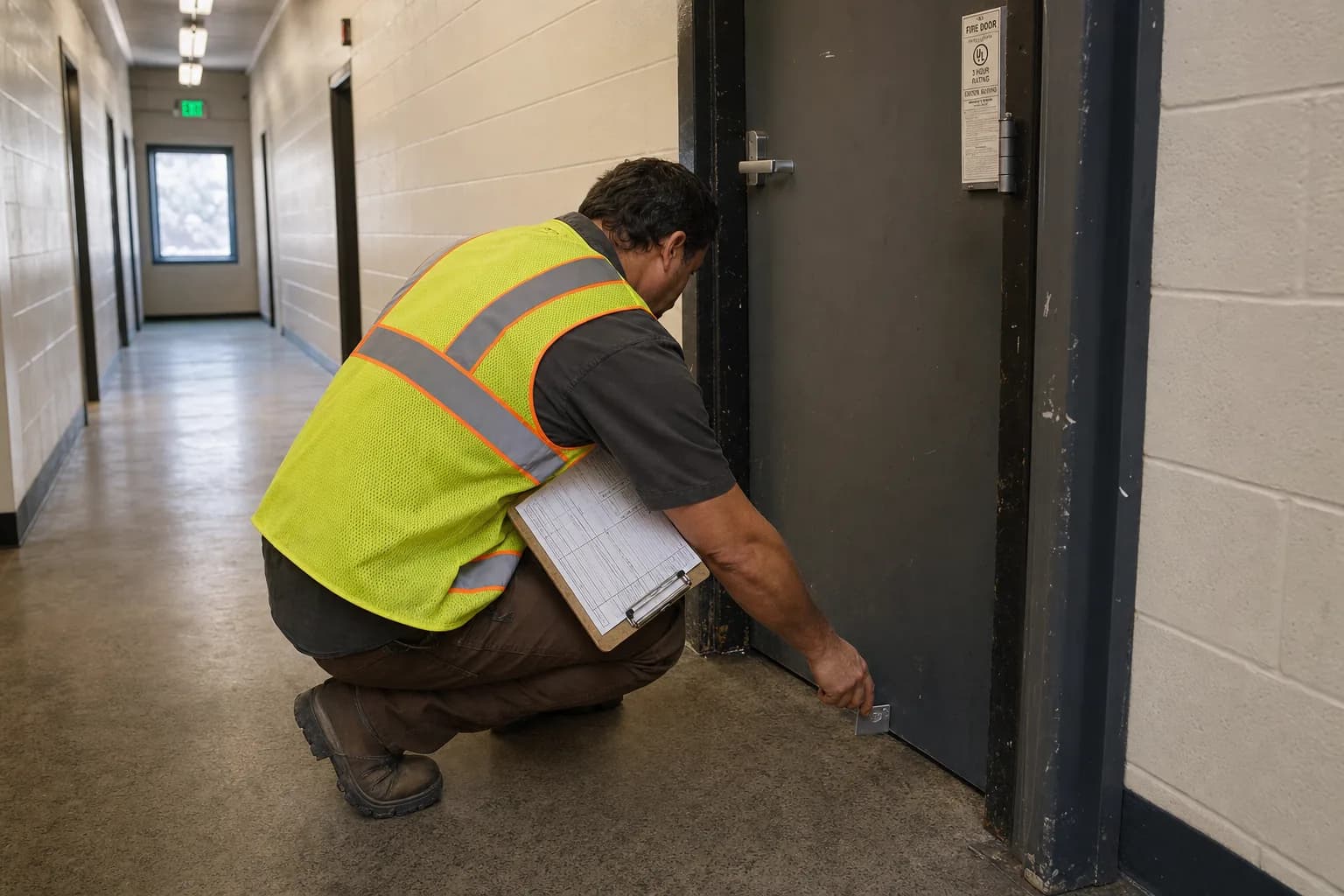
Clearance is one of the more precise items on an NFPA 80 inspection, and one of the more commonly failed. The gaps between a fire door and its frame determine how much smoke and hot gas can pass through before fire even reaches the assembly, so the tolerances stay tight.
| Location | Maximum Clearance |
|---|---|
| Head (top of door) | 1/8 inch |
| Jambs (sides of door) | 1/8 inch |
| Bottom of door (undercut) | 3/4 inch |
Inspectors typically use a gap gauge to take these measurements. A door that has swelled, a frame that has shifted, or a threshold that has worn down over time can push a previously compliant opening outside these tolerances without anyone noticing until an inspection catches it.
How Often NFPA 80 Requires Inspections
NFPA 80 requires you to inspect and test fire door assemblies at least once a year. That baseline is what most facility managers already know. What surprises people is that the standard also calls for inspection and testing at two other points: right after installing a fire door assembly, and again after any maintenance work on it.
As an alternative to the standard annual cycle, a facility can run a written, AHJ-approved performance-based inspection, testing, and maintenance program instead. That option mainly suits larger portfolios with dedicated facility staff, and it is worth raising with your local fire marshal if annual third-party inspections do not fit your operation.
We cover the scheduling and staffing side of this in more detail in our post on how often fire doors need to be inspected, including what happens if a building misses its inspection window.
Who Can Perform the Inspection and What Records to Keep
NFPA 80 requires a qualified person to do the inspecting, someone who, through knowledge, training, and experience, can evaluate a fire door assembly and correctly flag a deficiency. That can be an in-house facilities employee with the right training or a third-party fire door inspector, depending on how your organization handles it.
Whoever does the inspection has to produce a written record. The inspector signs that record, and your facility keeps it on file and makes it available for review by your local fire marshal or building department. If nobody has ever asked your facility to produce fire door inspection records during a walkthrough, plan for that day to arrive rather than betting it will not.
Two habits worth building into your process:
- Log deficiencies with a corrective action and a completion date, not just a note that gets left open.
- Track each door opening separately. A building with forty rated openings needs forty sets of inspection results, not one summary paragraph.
Common Deficiencies That Fail Inspection
A handful of problems show up again and again in commercial buildings, and routine attention prevents most of them without waiting for a full inspection cycle.
Doors propped open with a wedge or a doorstop rank among the most common findings, and among the most serious. A fire door only protects an opening while it stays closed, so propping it open defeats the entire purpose of the rated assembly.
Damaged or missing intumescent seals cause trouble just as often. These seals expand when they hit heat and close the gap around the door, so a cut, painted-over, or missing seal undermines that function even when the door itself looks intact.
Swapped hardware creates more compliance problems than most facility teams expect. When a closer or latch gets replaced with a hardware-store equivalent instead of a listed component rated for that assembly, the substitution can void the listing on the entire door even though nobody touched the door itself.
Over-clearance gaps, usually from a settled frame, a worn threshold, or a door that has swelled with humidity, slip past a casual walk-through easily and are exactly what a gap gauge exists to catch.
For a broader look at the maintenance side of this, our commercial door preventative maintenance checklist covers the routine upkeep that keeps assemblies from drifting out of compliance between inspection cycles. If you want the background on how fire ratings work, our post on fire door ratings explained breaks down what a 20, 45, 60, 90, or 180-minute rating means for a given opening.
Building an NFPA 80 Fire Door Inspection Program That Works
Staying compliant with NFPA 80 comes down less to any single inspection and more to a routine your facility actually follows: annual inspections on schedule, a qualified person doing the checking, records tracked opening by opening, and deficiencies corrected instead of noted and forgotten.
If your fire-rated door assemblies need service, replacement components, or a full assembly that meets current code, Innovate Window and Door works with commercial building owners and facility managers across Montrose, Delta, Grand Junction, and the rest of Western Colorado on exactly this kind of work. We source fire-rated commercial doors built to meet current code requirements, and we are happy to walk through what your building's openings need. Contact us for a free estimate on fire-rated door service, replacement, or a new commercial installation.
About the author
Jeremy Holzmeister is the founder of Innovate Window and Door, a locally owned window and door company in Montrose, Colorado, with more than fifteen years of experience in the trade. Learn more about our team.